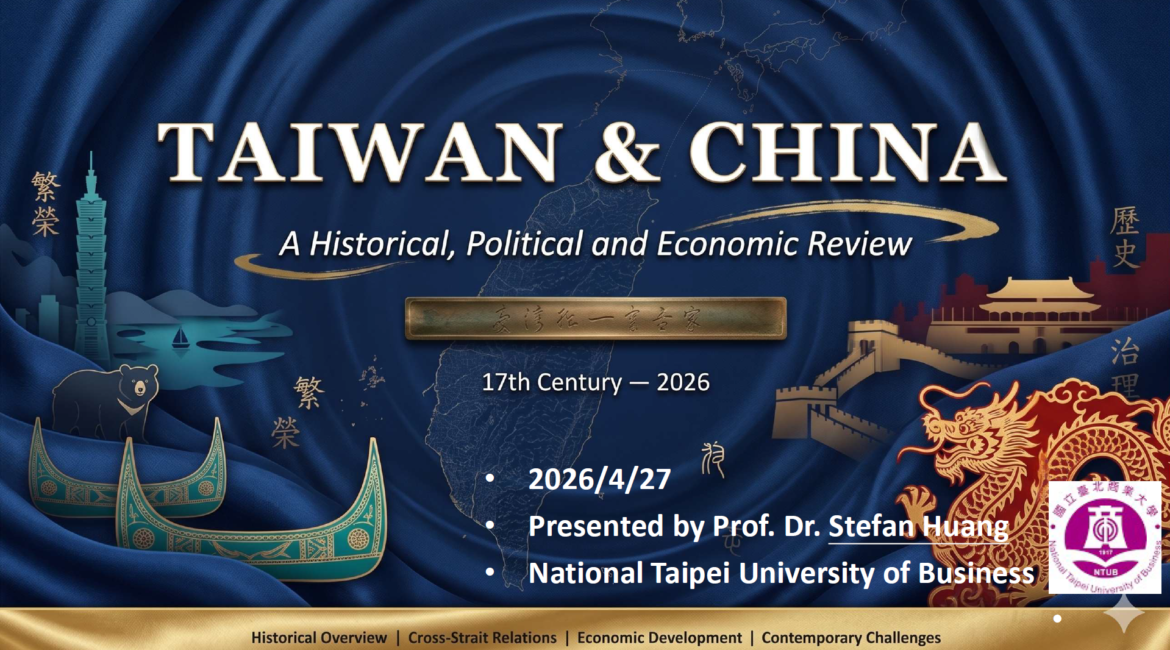
I was invited to NTUB’s sister university – German University of Aschaffenburg. Hereunder is AI refined presentation transcript.
Part I: Historical Background
Early Colonization (17th Century)
Taiwan’s recorded colonial history began in the 17th century with two competing European powers establishing footholds on the island:
- Dutch (VOC): Occupied the southern part of Taiwan. My own ancestors were brought to Taiwan by the Dutch East India Company (VOC) to work — establishing my family’s roots on the island nearly 300–400 years ago.
- Spanish: Occupied the northern part of the island.
Note: Remnants of these colonial sites can still be visited today, though much has changed over 400 years.
Koxinga & Ming Loyalists (1662–1683)
After the Ming dynasty was overthrown by the Qing dynasty (the Manchu people from Manchuria — the origin of what we now call “Mandarin”), a Ming loyalist warlord known as Koxinga (Zheng Chenggong) fled to Taiwan and expelled the Dutch, establishing his own rule for approximately 20 years. Taiwan was subsequently conquered by the Qing dynasty, though it remained a low priority for the Qing Emperor, who was focused on governing the mainland.
Japanese Colonial Period (1895–1945)
Following China’s defeat in the First Sino-Japanese War (1895), Taiwan was ceded to Japan as a territorial prize. Under Japanese rule for half a century:
- Initial resistance from local Chinese Taiwanese was eventually suppressed.
- Japan modernized and industrialized Taiwan, presenting it as a model state within its broader East Asian order.
- A cultural identity shift occurred: Taiwanese identity gradually moved from Chinese to Japanese. Many elderly Taiwanese today still speak Japanese as a result of growing up under this colonial period.
End of WWII & the Question of Sovereignty (1945–1952)
1945 marked the end of World War II and Japan’s surrender, but it did not resolve Taiwan’s legal status. Key points:
- San Francisco Peace Treaty (1951/52): Japan formally renounced sovereignty over Taiwan but did NOT name a recipient. Most international legal experts consider this the more legally binding document.
- Cairo Declaration (1943) / Potsdam Declaration (1945): Indicated Taiwan should be returned to China (the Republic of China). However, these are declarations, not binding treaties.
- UN Resolution 2758 (1971): Expelled the Republic of China from the UN and transferred China’s seat to the People’s Republic of China (PRC).
Result: Two governments both claiming to represent “China” — the Republic of China (ROC/Taiwan) and the People’s Republic of China (PRC/mainland) — a tension that persists to this day.
KMT Rule & the Great Retreat (1945–1949)
The KMT (Kuomintang / Republic of China government) took control of Taiwan after WWII, but its early governance was troubled:
- February 28 Incident (1947): A brutal crackdown in which thousands of Taiwanese were killed — a pivotal and painful moment in Taiwan’s history.
- Martial law was imposed following the incident.
- The Great Retreat (1949): After being defeated by the Chinese Communist Party, the KMT government retreated to Taiwan along with approximately 1 million soldiers and loyalists. Taiwan’s population at the time was only 7million.
Part II: Cross-Strait Relations & Political Dynamics
One China Policy vs. One China Principle
Understanding the distinction between these two terms is essential:
- One China Principle (PRC stance): There is only one China, and Taiwan is part of it.
- One China Policy (US stance): The United States acknowledges, but does not endorse, Beijing’s claim over Taiwan. This deliberate ambiguity creates diplomatic flexibility for political and military maneuvering.
Taiwan Strait Crises
There have been several major cross-strait crises:
- 1st Crisis: Taiwan defended Kinmen (Quemoy) and Matsu islands.
- 2nd Crisis (1958): Second bombardment of Kinmen.
- 3rd Crisis (1996): China fired missiles near Taiwan’s coast to intimidate voters ahead of Taiwan’s first direct presidential election.
- 4th/5th Crisis (2022): Triggered by U.S. House Speaker Nancy Pelosi’s visit to Taiwan in August 2022. China launched large-scale military exercises around the island.
Political Pendulum: KMT vs. DPP
Taiwan’s domestic politics have oscillated between two major parties with very different approaches to China:
- DPP (Democratic Progressive Party): More pro-independence rhetoric; governed 2000–2008 and 2016–present. Cross-strait tensions higher during these periods.
- KMT (Kuomintang): More engagement-oriented with Beijing; governed 2008–2016. Increased trade and exchanges, but also generated economic backlash as Taiwanese investment was heavily absorbed by China.
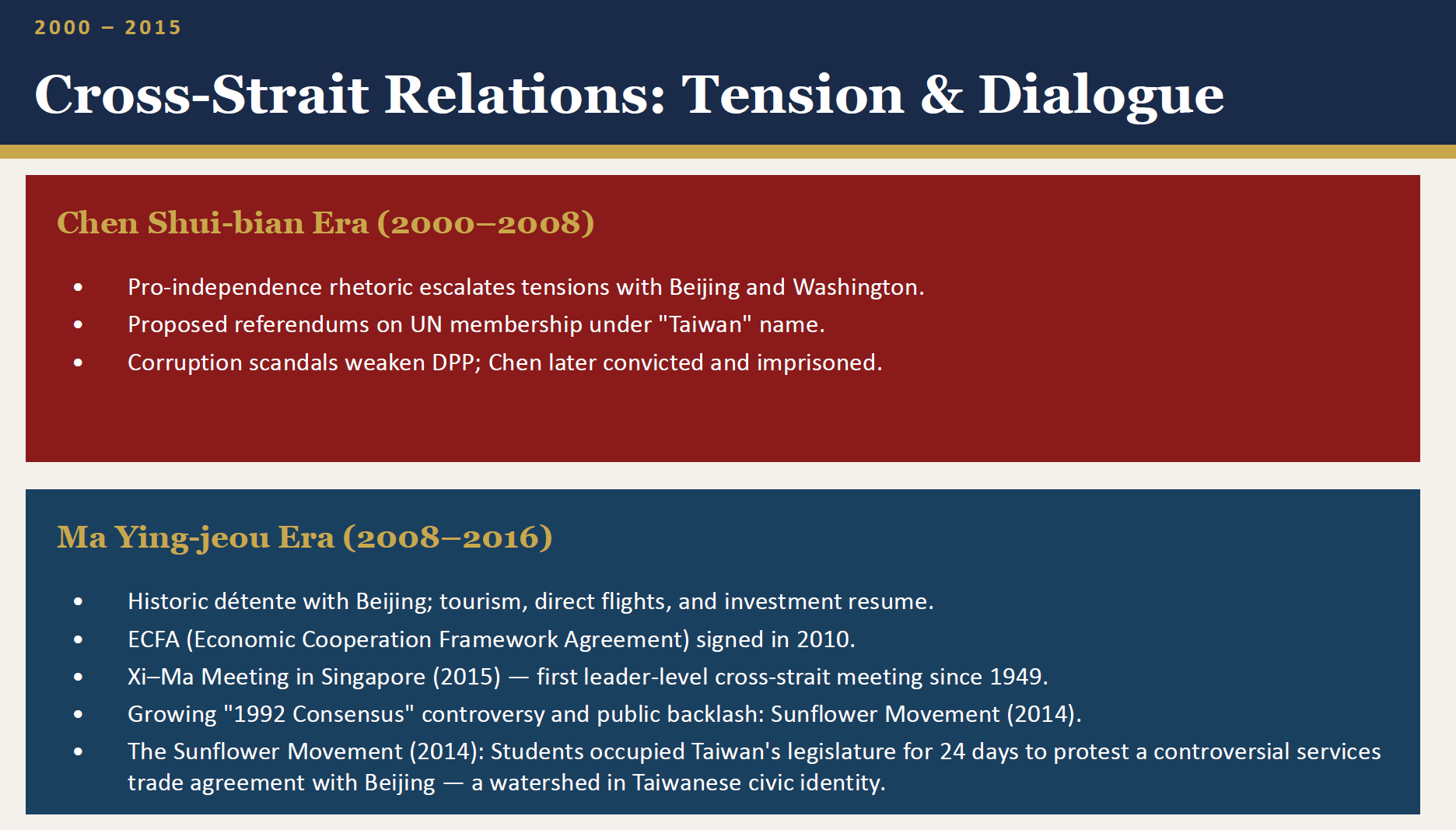
Today, Taiwan has a third consecutive DPP president. The KMT, as opposition, has opposed increased defense budgets for purchasing U.S. weapons — a stance many view as tilting toward appeasement.
Red Infiltration & Information Warfare
One of the most serious and underappreciated threats Taiwan faces is not military invasion, but subversion from within — what China calls the “United Front Work” strategy. The goal is to turn people against each other, erode trust in institutions, and ultimately win without ever sending troops.
Political & Military Infiltration
- Buying politicians: China has allegedly purchased the loyalty of politicians across party lines, including key figures within the KMT, through selective benefits and financial inducements.
- Bribing military officers: Senior military personnel have been targeted with bribes in exchange for classified military intelligence and secrets.
- Sanctions violations: Some Taiwanese businesses have been caught bypassing U.S. export sanctions — for example, illegally delivering high-end AI servers to China, in direct violation of U.S. sanctions law.
Disinformation & Social Media Manipulation
The information battlefield is active every day on platforms like Facebook, Instagram, and X (formerly Twitter). Common disinformation narratives include:
- False claims about foreign leaders (e.g., “Trump has already been assassinated”).
- Narratives undermining Taiwan’s technological standing (e.g., “Taiwan is weak; China is the world’s most advanced nation”).
- Amplifying social divisions, distrust in government, and defeatist sentiment.
A key vulnerability is media literacy: many Taiwanese citizens, particularly older generations, are not accustomed to cross-checking information across diverse sources, making them susceptible to accepting disinformation as fact.
A Shared Global Challenge
Taiwan is not alone in facing this threat. Germany and other democracies have experienced similar influence operations, though the scale and immediacy are especially acute for Taiwan given its geographic proximity and the PRC’s explicit territorial ambitions.
Part III: Taiwan’s Economic Landscape (2015–2025)
The Silicon Shield: Semiconductor Interdependency
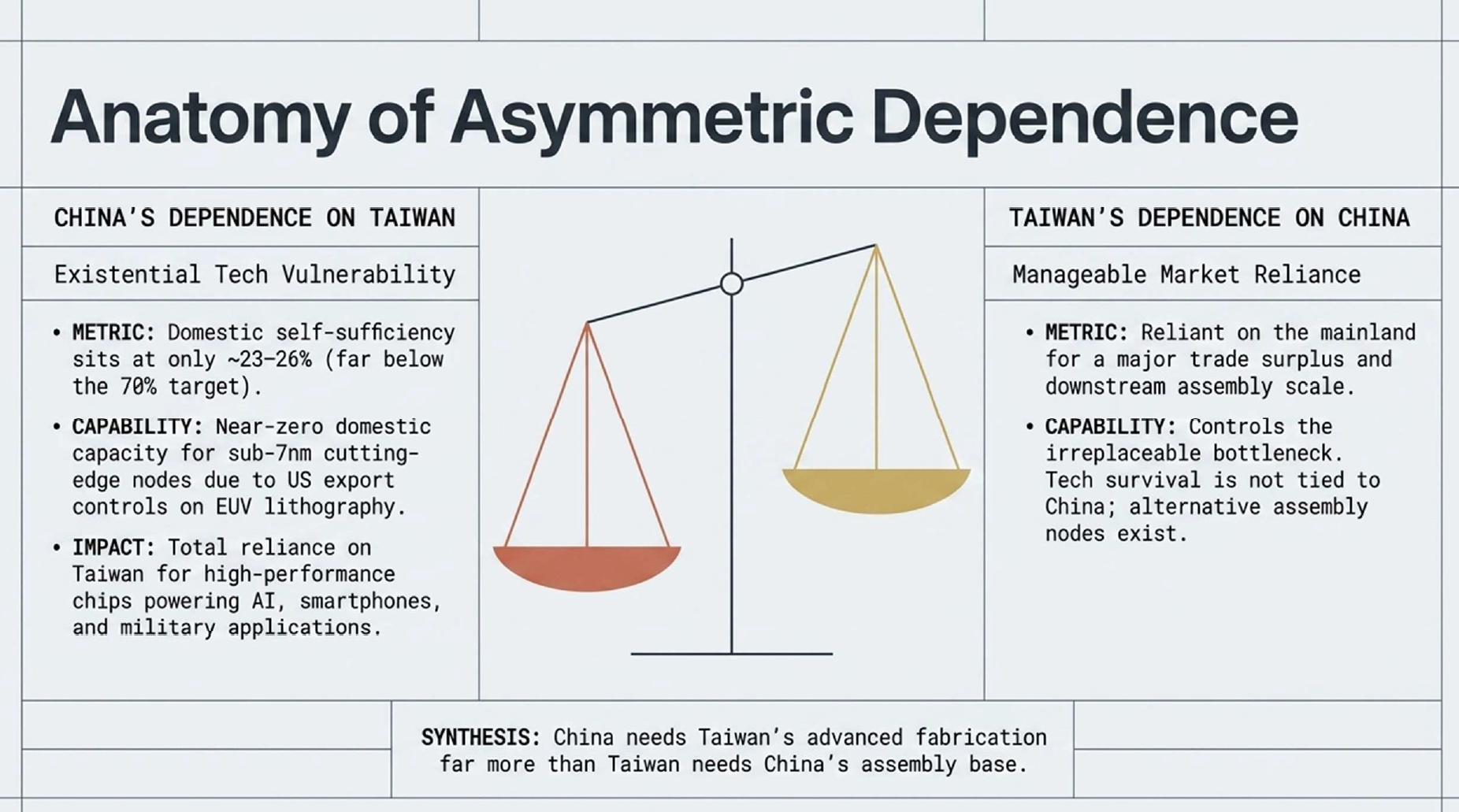
Taiwan’s most powerful economic and geopolitical asset is its dominance in semiconductor manufacturing:
- Taiwan designs and fabricates high-value integrated circuits (ICs).
- China has historically assembled these components into finished products (e.g., iPhones) for the global market.
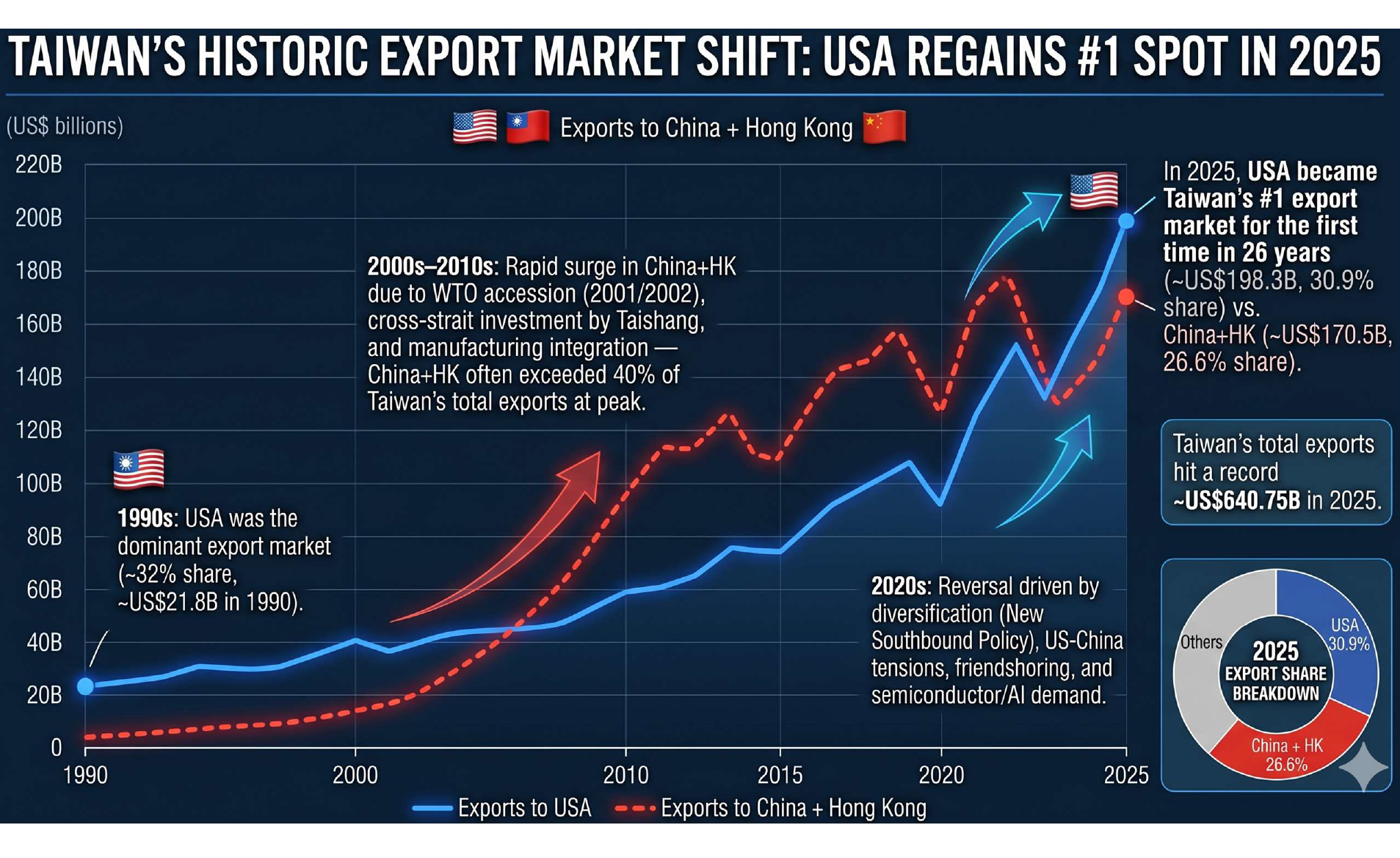
- Over 40% of Taiwan’s exports previously went to China.
- S. sanctions now restrict delivery of high-end chips to China.
- The most advanced chip manufacturing remains concentrated in Taiwan and Arizona (TSMC).
Trade Volume Trends
Cross-strait trade volume shows a clear arc:
- 2019–2022: Sharp increase driven by surging global demand for electronics during COVID-19.
- 2021–2022: Peak trade volume.
- 2023: Total cross-strait trade fell to USD 267.8 billion, a decline of 15.6% year-on-year. Imports from China dropped ~16%, driven largely by a sharp fall in traditional commodity trade.
Decoupling & Supply Chain Diversification
The geopolitical turning point came in 2018 with the U.S.–China trade war, accelerated by COVID-19, which exposed the risks of over-reliance on Chinese production:
- “China Plus One” strategy: Taiwanese businesses are diversifying production to Vietnam, India, and other countries with similar cost structures.
- Global capital is realigning away from China toward friendly nations.
- China employs a “carrot and stick” approach — selectively granting trade benefits (ECFA) to compliant Taiwanese industries while using non-tariff barriers (e.g., excessive inspection standards on agricultural products) against others.
Taiwan’s New Trade Landscape (2025)
A significant shift has occurred in Taiwan’s top trade partners:
- The USA has overtaken China + Hong Kong to become Taiwan’s #1 export destination.
- Taiwan’s exports to the U.S. — dominated by computers, office machinery, and semiconductors — exceed 60% of total U.S.-bound exports.
- AI-driven growth: In 2025, AI server exports saw 127% explosive growth.
- GDP growth: Initially forecast at 3.5% for 2024, Taiwan ultimately recorded 8.6% growth — a 15-year high, largely powered by AI and semiconductor demand.
Asymmetric Dependency
China is more dependent on Taiwan than vice versa. China relies on Taiwan’s high-tech components to power its low-cost assembly and export model. Taiwan, meanwhile, can increasingly redirect these exports to the U.S., Europe, and Japan — reducing its economic vulnerability.
Conclusion: Taiwan’s Three Pillars of Stability
Despite persistent cross-strait tensions — a reality Taiwan has lived with for over 70 years — the island continues to thrive. Its resilience rests on three strategic alliances:
- United States: Primary security guarantor and now largest export market.
- Europe: Growing economic and political alignment, including TSMC’s chip fab in Dresden, Germany.
- Japan: Firm military, political, and cultural alliance with shared regional security interests.
Taiwan’s story is complicated but fascinating — a small island navigating enormous geopolitical forces while achieving remarkable economic success.